


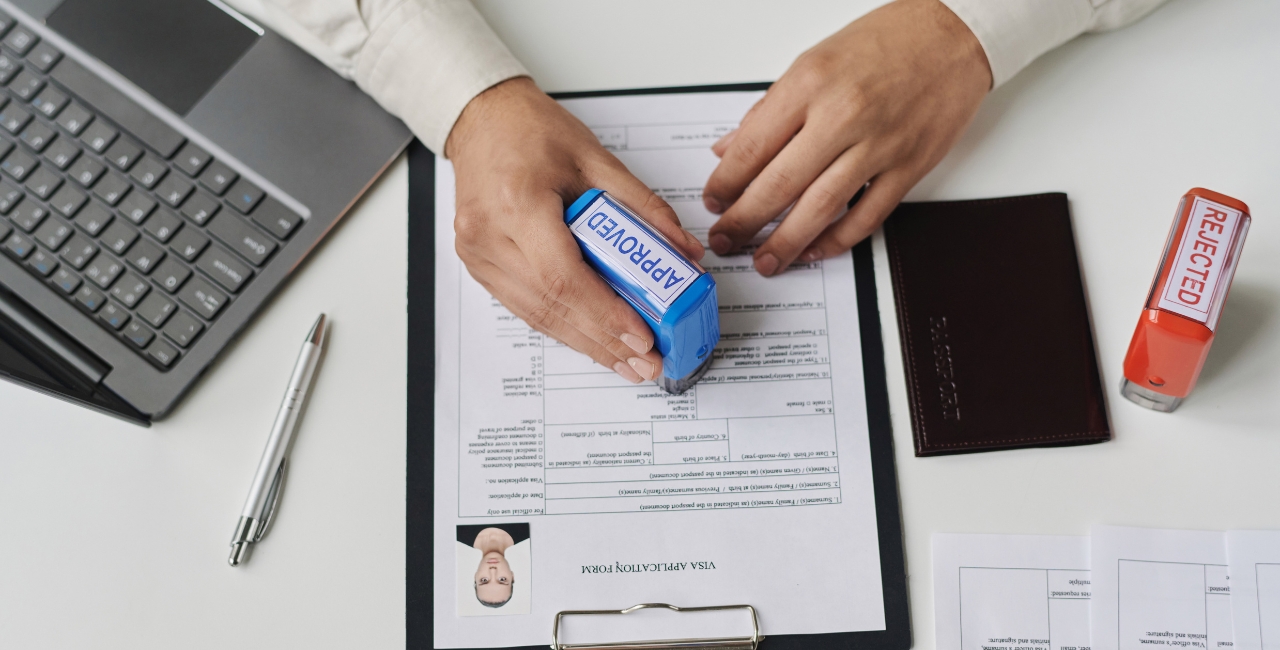

You have a business meeting in New York. Or maybe your cousin is getting married in California. Or maybe you just want to spend two weeks eating your way through Chicago.
Makes sense. Simple trip. No big deal, right?
Whatever brings you to the United States, the path usually starts with the B-1/B-2 visitor visa.
For millions of applicants worldwide, the B-1/B-2 visa is the most common US visa type. And yet, it’s also one of the most misunderstood.
People are rejected not for ineligibility but for failing to understand what the consular officer was looking for. Others walk into the interview underprepared. Some submit an incomplete DS-160 form without even realizing it.
What Is The B-1/B-2 Visitor Visa?
The B-1/B-2 visa is a type of US non-immigrant visa that allows foreign nationals to travel to the United States for a temporary period of time. This visa has two categories, which can usually be issued together on the same visa stamp:
1) B-1 (Business Visitor): For visitors who are traveling on business (e.g., business meeting, conference or convention, negotiating contracts, consultation with business associates, or training).
2) B-2 (Tourist): For visitors who are traveling for fun/vacation (e.g., visiting family or friends, receiving medical attention, or participating in an event, such as a sport event or music event).
In most cases, consulates issue a combined B-1/B-2 visa, which covers both purposes. That’s actually convenient; if your trip includes both a business meeting and a few days of sightseeing, you can use just one stamp.
Who Needs A B-1/B-2 Visa?
Not everyone needs this visa. Citizens of 42 countries can visit the US for up to 90 days without a visa under the Visa Waiver Program (VWP), as long as they have an approved ESTA (Electronic System for Travel Authorization). Countries like the UK, Germany, Japan, Australia, and South Korea participate in this program.
However, citizens of countries not on the VWP list, including India, China, Pakistan, Bangladesh, Nigeria, the Philippines, and many others, must apply for a B-1/B-2 visa before they can travel to the USA.
Even VWP travelers sometimes need to apply for a B-2 visa, for example, if they plan to stay longer than 90 days or if a previous VWP entry was denied.
What Activities Are Covered And What Are Not In A B-1/B-2 Visa?
This section is where many applicants get confused. Let’s be specific.
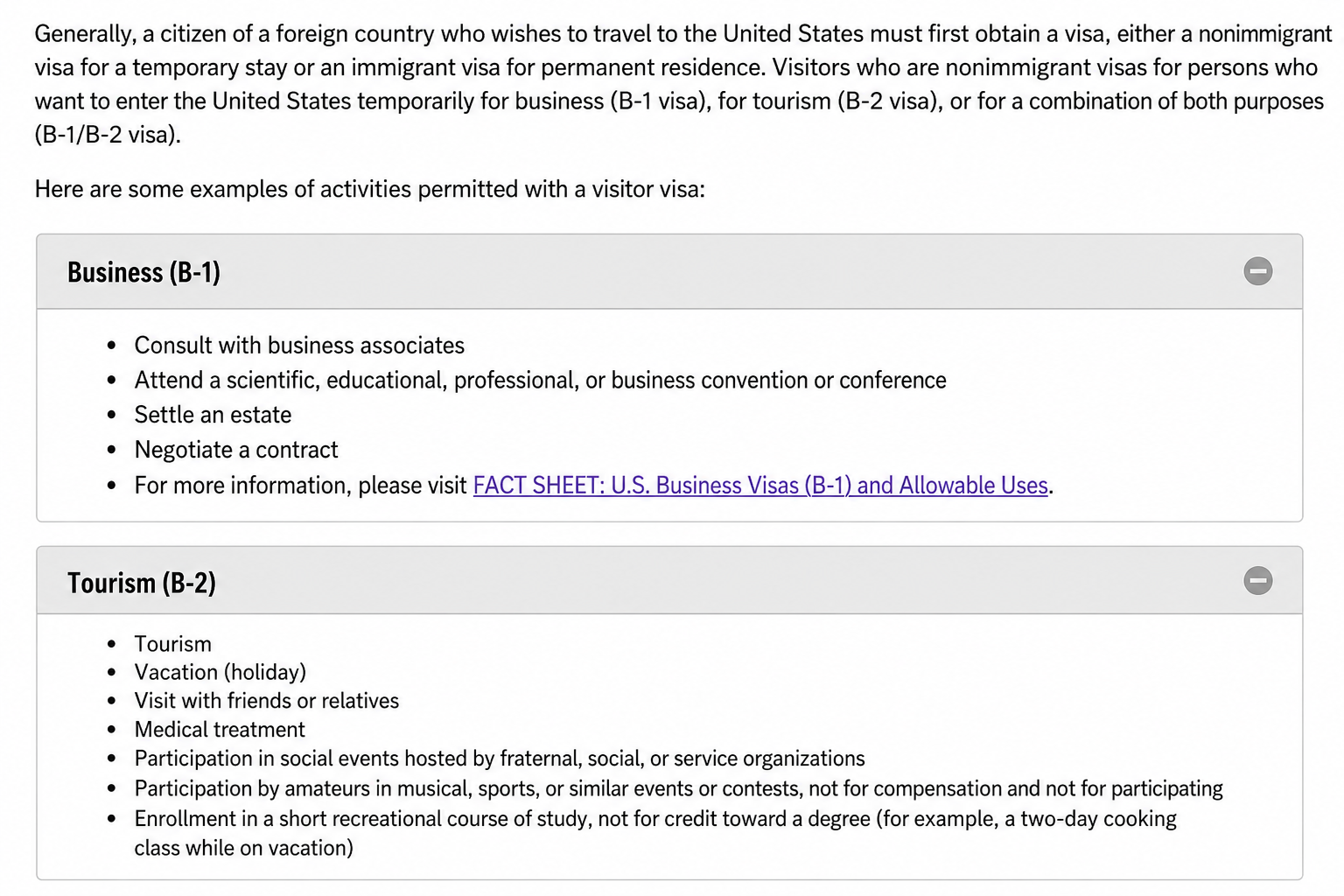
Allowed under B-1 (Business):
- Attending board meetings, conferences, or trade shows
- Negotiating contracts (but not signing and executing work there)
- Consulting with business associates or clients
- Short-term training (if the training is provided by a US company you're associated with and you're not being paid by a US entity)
- Participating in scientific, educational, or professional conventions
Participating in scientific, educational, or professional conventions
- Sightseeing, vacationing, and recreational travel
- Visiting family or friends
- Receiving medical treatment (with documentation from treating physician)
- Participating in amateur sports events or musical performances (unpaid)
- Short recreational courses that are not for credit (like a one-week cooking class)
Not Allowed Under Either B-1 Or B-2:
- Taking up paid employment with a US employer
- Performing as a professional entertainer or athlete for payment
- Enrolling as a full-time student (F-1 visa required)
- Reporting as a journalist or media member (I visa required)
- Working as a crew member on a US vessel or aircraft
Pro Tip: If you’re unsure whether your specific activity qualifies under B-1 or B-2, it’s worth getting a professional opinion from The Visa Way before applying. A wrong categorization can complicate your application unnecessarily.
B-1/B-2 Visa Eligibility Requirements
The US Embassy will not simply issue someone a visa due to their application. You are required to demonstrate that you meet certain eligibility requirements. The following are the most important ones:
1. Intent to Stay Temporarily
You will need to provide proof that you are coming to the United States for a limited amount of time and that you will go back to your home country after your authorized stay. This is referred to as “non-immigrant intent,” and this is arguably the most important factor when you are applying for a B visa.
2. Links to Your Home Country
Consuls are trained to look for the “links” that will cause you to return home, including your work, family, property, schooling, or business. The stronger your links to your home country, the more credible your claim of a temporary visit to the USA will be.
3. Financial Support of Your Trip
The applicant must provide proof that they have enough financial resources to support themselves while in the United States. This does not mean the applicant must be wealthy, only that they will not need to seek employment in the United States to fund their trip.
4. No Grounds of Inadmissibility
Certain reasons will make you inadmissible to enter the US, regardless of any other qualifications. Some examples of these reasons include having a history of overstaying a previous visa, a criminal history, previous removals, and previous misrepresentation on an application. Each of these situations must be handled with care.
Documents Required For B-1/B-2 Visa Application
It is essential to ensure your documentation is in order, as it will simplify the application process. Most US visa applicants will need the following core and supporting documentation:
Core documentation:
- Valid passport (must be valid for 6 months or more past your planned stay)
- DS-160 online non-immigrant visa application; must submit a completed application
- Barcode confirmation page on DS-160
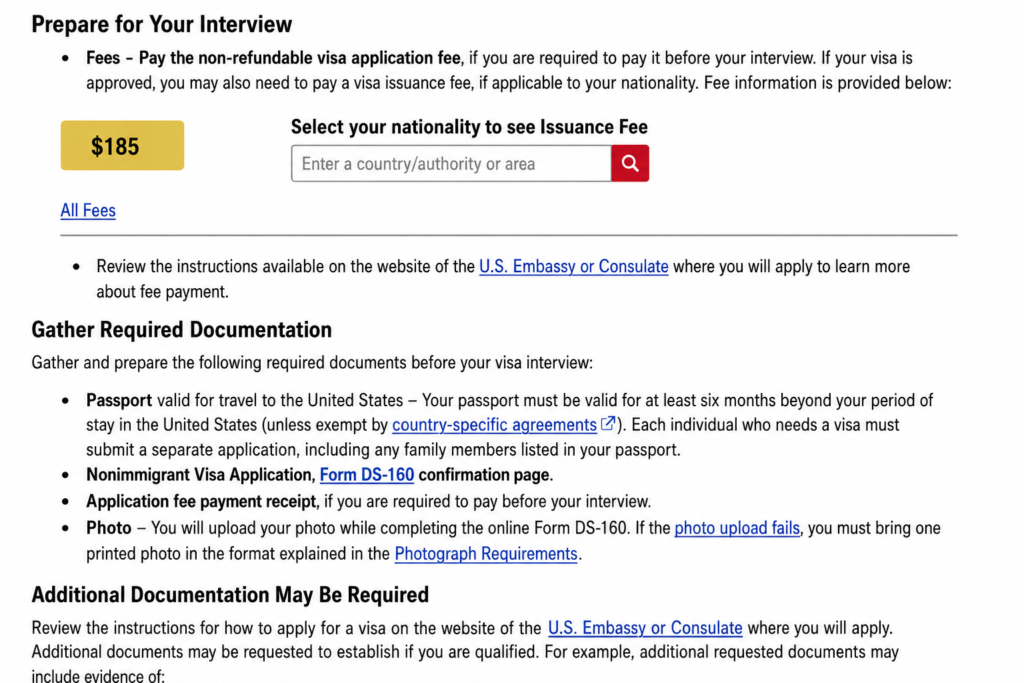
- Payment receipt of visa application fee (currently $185 USD)
- Current passport photograph (meeting US passport photo specifications)
Supporting documentation:
- Bank statements covering the last 3-6 months
- Proof of employment (employment letter, recent pay stubs)
- If self-employed, must have: business registration papers, prior year tax returns
- If you are a student, proof of enrollment with your school
- Proof of ownership of property (if applicable)
- Proof of family ties to the US (marriage certificate, children’s birth certificates)
- Round-trip airline tickets (or proof of airline reservation)
- Hotel reservation, or an invitation letter from a host in the US
- Proof of travel insurance (while not required, it offers additional credibility to your application)
If applying for a B-1 visa (business-related):
- Send an invitation letter from a US company or conference organizer
- Applicable details of business meetings or events
- Proof of the applicant's role with the business
If applying for a B-2 visa (medical care)
- Letter from the applicant's physician in the US
- Details of medical issues and planned treatments.
- Proof that the applicant will pay for their medical care.
*Important Note: Document requirements can vary by country and individual circumstances. Always check the specific US Embassy or Consulate website for your jurisdiction before your appointment.
Step-By-Step: How To Apply For A B-1/B-2 Visa
The application process follows a clear sequence. Here’s how it typically works.
Step 1: Fill Out The DS-160 Form
The official application for a US non-immigrant visa is called the DS-160. Take your time when filling out the form; inconsistencies or mistakes in a DS-160 can lead to significant complications during the interview process. You should be honest and specific.
Step 2: Submit The MRV Application Fee
You must pay the non-refundable (currently $185 USD) visa application fee before you can make an appointment. Each US Embassy will have its own instructions on how to make payment based on your country’s preferred payment method.
Step 3: Book Your Visa Interview
You may schedule your visa interview online through the US Embassy’s or Consulate’s appointment system based on your country. Please note that you may have to wait anywhere from a few days (e.g., some countries) to several months (e.g., India and other high-volume applicants) to receive an appointment. Please prepare well before your appointment time.
Step 4: Assemble Your Required Documents
Collect all of the documents listed above and organize them so that they are easy to find. Make sure that you bring original documents and photocopies if required.
Step 5: Go to Your Visa Interview
This is the most important step, as you will meet with a consular officer who will ask about your travel purpose, ties to your home country, and financial situation. Interviews typically last 2 to 5 minutes. Be truthful and confident.
Step 6: Visa Processing and Collection
Usually, after the interview, your passport will be kept until the visa is stamped inside it. Processing time can take from days to weeks. You will pick up your passport (with the visa stamped inside) from the specified courier service or pickup point.
The Visa Interview: What To Expect And How To Prepare
Many applicants stress out about the interview more than they should. The consulate officer is there to see if you genuinely qualify for the visa, so if you do and present yourself clearly, you shouldn’t be nervous.
Some common Interview Questions Include
- Why are you visiting? you shouldn’t
- How long will you be staying?
- Where will you be staying?
- Who is paying for your trip?
- Do you have family/friends in the United States?
- What do you do (job/occupation)?
- Have you ever visited the United States before?
Suggestions That May Help You Be Successful In Your Interview
- Answer questions honestly and directly without excessive explanation or rambling.
- Be consistent with what you filled out on your DS-160 application.
- Have all your background documentation ready and accessible, but don’t offer it to the officer unless asked.
- If you are unsure about a question, ask for clarification instead of guessing.
- Be honest; any misrepresentation, even a small one, can result in a permanent ban.
Some of the things that you should avoid In An interview
- Providing memorized, scripted answers that sound as if you have rehearsed.
- Answering vaguely or inconsistently regarding the purpose of your trip.
- Being unclear about your financial situation.
Common Mistakes That Lead To B-1/B-2 Visa Rejection
Let’s talk about what actually goes wrong. These are patterns that visa consultants see repeatedly.
1. Lack of Strong Home Country Ties
The main reason for denial is a weak connection to the home country. If an applicant is young, single, out of work, or recently graduated and is applying for a visa to the US, the consular officer may be concerned about whether the applicant will return to their home country. The best way to prove ties to your home country is to provide the officer with documents showing as many connections as possible.
2. Inconsistent Answers
If an applicant gives a different response on their DS-160 than what they provided during their interview, including even small discrepancies, then that will raise red flags for the consular officer.
3. Insufficient Financial Evidence
If the applicant does not provide evidence of sufficient financial resources to fund their travel, such as bank statements that accurately depict their ability to pay for the travel, or if their account does not have sufficient funds at the time of their application, the consular officer may deny the visa due to insufficient financial evidence.
4. Previous Travel History
If an applicant has previously overstayed a US visa or has been previously denied entry to the US, they should proactively work to resolve those issues before applying for a visa again and not rely on the consular officer to disregard those prior problems.
5. Omissions
If an applicant does not disclose a previous visa refusal from the previous application, even if they meant to do it by mistake (and the form specifically asks about it), the officer will judge that applicant to have made a misrepresentation when he or she did not.
6. Poorly Worded Documents
If the applicant’s documents do not match the information on their DS-160 (e.g., the invitation letter is unclear, the bank statement is different from the declared income, or the employment letter does not present a leave approval).
B-1/B-2 Visa Rejection Reasons
Example 1: The Fresh Graduate
When you graduated and had no job or property, the United States rejected you because your connection to your home country was weak. To get your visit approved, you must show the US that you have a reason to return.
Example 2: The Self-Employed Applicant
If you own a business and have money in your bank accounts but have never filed taxes in the USA, you will probably be turned down for your application to visit. The only way to demonstrate that you were an authorized business owner was to file your taxes.
Example 3: The Overstay
You were turned down for your application when you previously stayed seven months but only had six months on your visitor status. Immigration violations last forever, so if you ever overstay, it will be permanently on record and affect all future applications to the USA.
Example 4: The Unknown Traveler
“I’m coming to the USA just to see it” will not get you through. A much better way to get your visa is to say, “I’m going to the USA for four days in New York and three days in Washington, D.C.”
Visa Validity, Duration Of Stay, And Extensions
Many people make the mistake of thinking there is no difference between a visa validity time and an authorized period of stay. But here it is:
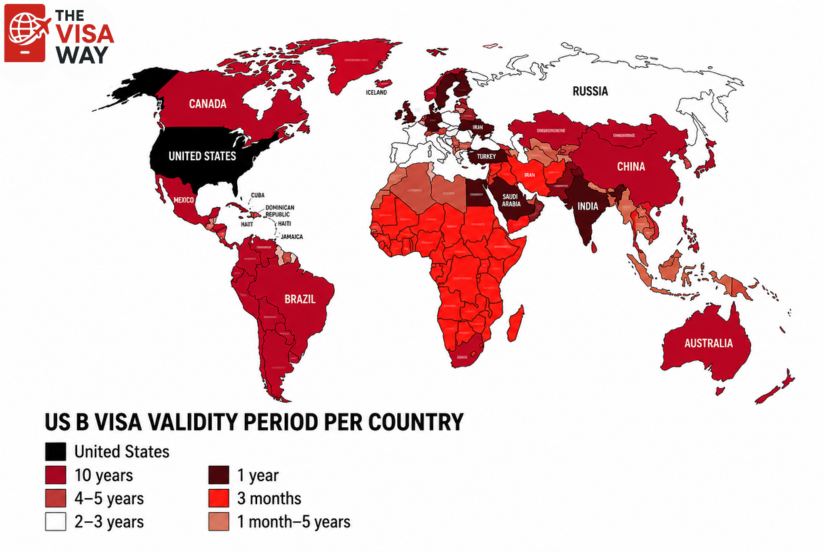
Visa Validity: The amount of time you can enter the USA using your visa (for example, if you have a 10-year multiple-entry B-1/B-2 visa, you can enter the USA numerous times over a period of 10 years) does not mean you can stay in the USA for 10 years continuously.
Length of Stay: The length of time that you can stay is determined by a Customs and Border Protection (CBP) officer after you arrive at a port of entry and will be either written in your passport or listed electronically on your I-94. Most B-1/B-2 visa holders will be able to stay for a maximum of 6 months.
If you feel you want to stay in the USA past your authorized period of stay, you may apply to USCIS for an extension of stay using Form I-539 before your authorized stay ends; approval is not guaranteed. Any overstay of your visa period, even by one day, will have significant negative consequences for your ability to apply for a visa in the future.
How Much Does The B-1/B-2 Visa Cost?
The standard non-refundable MRV application fee is $185 USD. This must be paid regardless of whether your visa is approved or denied.
Some applicants may also pay for:
- Optional visa appointment scheduling services
- Courier/document delivery fees
- Reciprocity fees (for citizens of certain countries where the US charges an additional fee based on reciprocal arrangements; check the US Embassy website for your country)
- There is no additional fee for the B-1/B-2 visa stamp itself, beyond the MRV fee.
Processing Time: How Long Does It Take?
Processing times vary a lot depending on which US Embassy or Consulate you apply to. Here’s a general idea, but always check the official website before booking anything.
Once your interview is done, visa processing can take anywhere from a few days to several weeks. Sometimes it’s faster, sometimes slower; it really depends on your case.
*Important: Don’t rely on old information. Always visit the official US Embassy website for your country to see exactly how long the wait is right now.
Myths vs. Facts About the B-1/B-2 Visa
Final Thoughts
The B-1/B-2 visa isn’t complicated, but it does ask you to be honest, prepared, and clear about your plans.
The people who get approved aren’t always the richest or the most well-traveled. They’re the ones who understand what the officer is looking for: a genuine visitor with real reasons to go back home.
So take your time. Gather your papers. Be honest in your interview. And if something in your situation feels tricky, like a past refusal, an unusual job, or a family in the US, don’t guess.
If you’re still unsure about your documents or how to present your case, the team at The Visa Way is here to help. CONTACT US NOW!
Your US trip is absolutely possible. Just take it seriously, prepare well, and give your application the attention it deserves.
submitting your visa application
Frequently Asked Questions

Akash Pundir is the Chief Operating Officer at The Visa Way and Document Evaluation LLC, bringing over 5 years of international business operations and legal support experience across the United States, Australia, and India. He has overseen the strategic positioning and analysis of over 1,000+ complex USCIS cases, specializing in guiding expert evaluation teams to draft high-stakes Expert Opinion Letters (EOL), Academic Equivalencies, and defense packets for H-1B, EB-2 NIW, RFEs, and NOIDs. Driven by digital transformation, Akash ensures every evaluation adheres strictly to the latest USCIS legal frameworks and compliance benchmarks.