







Key Takeaway
- The Grand Canyon showcases 1.8 billion years of Earth's history.
- It was carved by the Colorado River over millions of years.
- The park is home to rich wildlife and diverse ecosystems.
- It is both a UNESCO World Heritage Site and a place of deep cultural significance.
- Responsible tourism helps preserve this natural wonder for future generations.
The Grand Canyon National Park is a national landmark in America and receives MILLIONS of tourists annually. Situated in northern Arizona, the Grand Canyon National Park is popular due to the presence of the Grand Canyon which is one of the deepest and widest canyons in the WORLD, created through years by the Colorado River.
The site provides many beautiful viewpoints, trails, scenic drives, and even a chance to study the geology and history of the area. If you plan to pay tribute to nature and explore this park, it helps to know some key facts about it.
Key Facts About Grand Canyon National Park
Grand Canyon National Park, located in the northern part of Arizona, is one of the most popular national parks in America. This national park serves as a home to the Grand Canyon, which is a natural monument created by the Colorado River throughout many years. This natural monument occupies more than 1.2 million acres and includes rock structures, deep canyons, beautiful views, and various wild animals. Grand Canyon National Park was established in 1919 and recognized as a UNESCO World Heritage Site in 1979. This national park is renowned for its geology, culture, and ecosystems.
Grand Canyon National Park: Size, Geography & Dimensions
| Measurement | Data |
|---|---|
| Total Park Area | 1,218,375 acres (493,059 ha), or 1,904 sq miles (4,931 km²) |
| Canyon Length | 278 river miles (447 km) from Lees Ferry to Grand Wash Cliffs |
| Canyon Width | Average 10 miles (16 km) rim-to-rim; maximum 18 miles (28.8 km); minimum 600 feet (180 m) at Marble Canyon |
| Canyon Depth | Average 1 mile (1.6 km); deepest point 6,000 feet (1,829 m) |
| South Rim Elevation | 7,000 feet (2,100 m) |
| North Rim Elevation | 8,000 feet (2,400 m) |
| Phantom Ranch Elevation | 2,400 feet (720 m) |
| Canyon Volume | 5.45 trillion cubic yards (4.17 trillion m³) |
| Colorado River (within canyon) | Length: 278 miles; average width: 300 feet; average depth: 40 feet; greatest depth: 85 feet |
Grand Canyon National Park Geology & Formation Facts
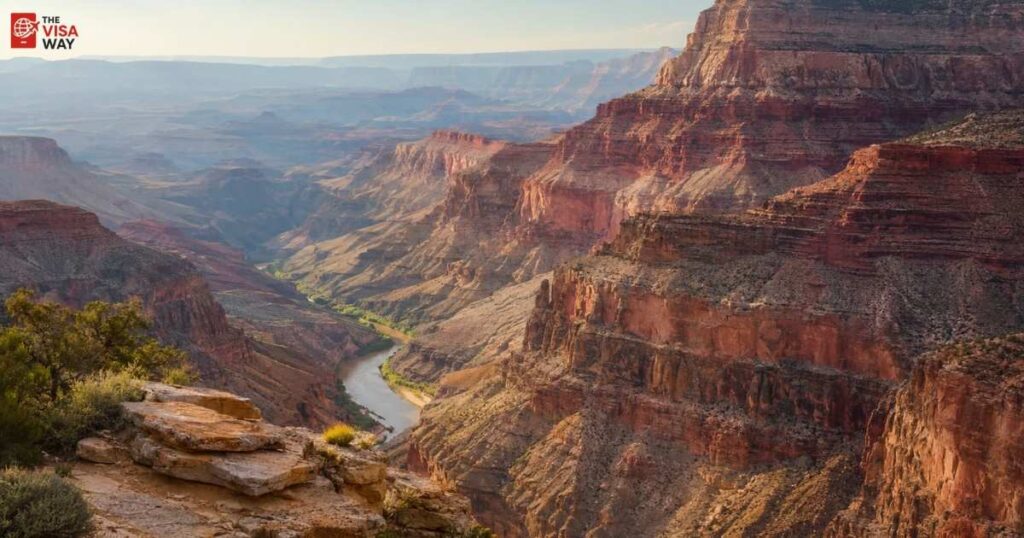
- Age of Rocks: The canyon exposes rocks ranging from 1.8 billion years old (Precambrian) to 230 million years old (Triassic).
- Three Main Rock Sets:
- Vishnu Basement Rocks: 1.375-1.84 billion years old, metamorphic and igneous rocks formed from volcanic island chains
- Grand Canyon Supergroup: 729-1,255 million years old, tilted sedimentary and volcanic rocks up to 12,000 feet thick
- Layered Paleozoic Rocks: 270-530 million years old, flat-lying sedimentary layers 3,000-5,000 feet thick
3. Total Stratigraphic Units: Over 180 named units, including 35 formations and 53 members.
4. Canyon Formation: The Colorado River established its course approximately 6 million years ago. The canyon was carved through a combination of river erosion, tectonic uplift (the Colorado Plateau rose ~70 million years ago), and weathering.
5. Fossil Record: Nearly 350 fossil localities with specimens ranging from 1.2-billion-year-old stromatolites to Pleistocene megafauna. The canyon has an almost complete fossil record from 2 billion to 270 million years ago.
6. Caves: Over 1,000 caves are thought to exist, with about 335 recorded. Only the Cave of the Domes on Horseshoe Mesa is open to the public
7. Volcanic Activity: Volcanic activity began about 6 million years ago and continued within the last several thousand years. Lava flows and cinder cones are visible on the Shivwits and Uinkaret plateaus.
Grand Canyon National Park Weather & Climate Facts
| Location | Average High Temp | Average Low Temp | Average Annual Rainfall |
|---|---|---|---|
| South Rim (7,000 ft) | 64°F (17.8°C) | 29.5°F (-1.4°C) | 13.4 inches (34 cm) |
| North Rim (8,000 ft) | 55°F (12.8°C) | 31.7°F (-0.2°C) | 24.2 inches (61.5 cm) |
| Phantom Ranch (Inner Canyon) | 81°F (27.2°C) | 54.2°F (12.3°C) | 9.6 inches (24 cm) |
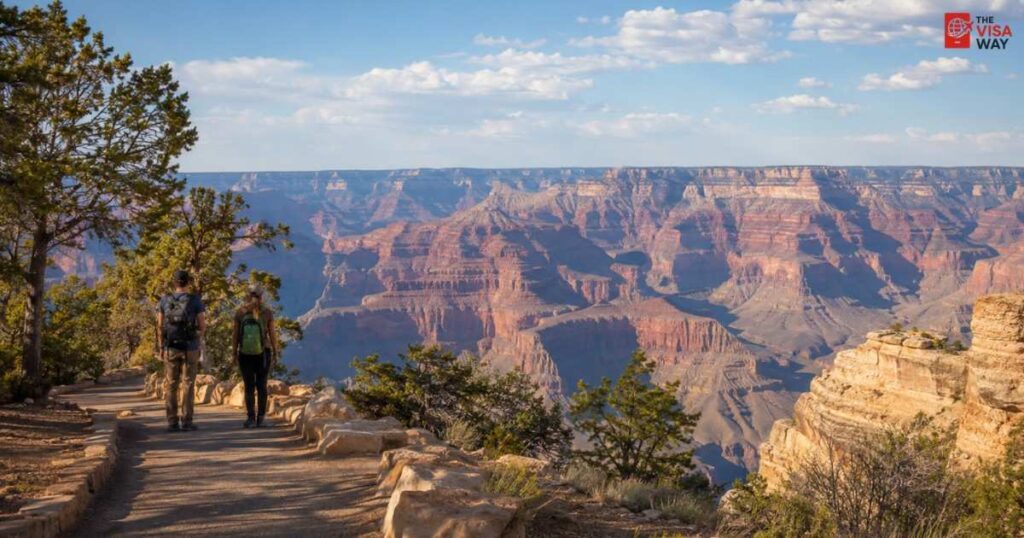
Temperature Range: Coldest recorded: 22°F on North Rim (Feb 1, 1985); hottest: 120°F at Phantom Ranch.
- Elevation Effect: Temperature increases about 5.5°F per 1,000 feet of loss in elevation.
- Snowfall: The North Rim averages 142 inches annually (record 272.8″ in 1978); the South Rim averages 58 inches. Phantom Ranch gets less than 1 inch.
- Summer Monsoon: July-August brings sudden thunderstorms with potential for flash floods and lightning.
- Life Zones: The park contains 5 of the 7 life zones found in North America, equivalent to traveling from Mexico to Canada.
Grand Canyon National Park History & Cultural Facts
- First Inhabitants: The oldest human artifacts date to the Paleoindian period (~12,000 years ago).
- Prehistoric Cultures: Evidence of Paleoindian, Archaic, Basketmaker, Ancestral Puebloan (Kayenta and Virgin branches), Cohonina, Cerbat, Pai, and Southern Paiute cultures.
- Associated Tribes: 11 federally recognized tribes are connected to the canyon: Havasupai, Hopi, Hualapai, Kaibab Band of Paiute Indians, Las Vegas Paiute, Moapa Band of Paiute Indians, Navajo Nation, Paiute Indian Tribe of Utah, San Juan Southern Paiute, Pueblo of Zuni, and Yavapai-Apache Nation.
- Historic Sites: 3,391 documented ancestral sites from the prehistoric period; 453 locations with evidence of historic Native American use (1540-1950).
- National Park Designation: Established February 26, 1919, as the nation’s 17th national park.
- UNESCO World Heritage Site: Designated in 1979.
- Dark Sky Park: Received provisional Dark Sky Park status in 2016.
- First Women to Boat the Canyon: Elzada Clover and Lois Jotter became the first women to boat the length of the Grand Canyon in 1938.
- National Historic Landmarks: 4 individual buildings, 3 districts, and 1 site.
- National Register: 8 buildings, 10 districts, 2 sites, 1 structure.
- Museum Collection: Over 900,000 objects preserving cultural and natural history.
Frequently Asked Questions
It is about a mile deep on average (1.6 km), although the deepest section drops to 6,000 feet (1,829 m). Its width reaches up to 18 miles (28.8 km), and the canyon extends for 278 river miles (447 km).
The Grand Canyon was formed mainly by the Colorado River cutting through layers of rock over millions of years. The uplift of the Colorado Plateau, which began roughly 70 million years ago, also played a major role. Wind, rain, erosion, and ancient volcanic activity further shaped the canyon.
No. Tibet's Yarlung Tsangpo Grand Canyon is more than 2 miles (3.2 km) deeper. The Grand Canyon is famous for its enormous scale, colorful rock formations, and walls that reveal a remarkable record of Earth's geological history.
Grand Canyon officially became a national park on February 26, 1919, making it the 17th national park established in the United States. In 1979, UNESCO designated it a World Heritage Site.
Grand Canyon National Park received 4,430,653 visitors in 2025. Most visitors go to the South Rim because it remains open throughout the year, while the North Rim typically closes during winter.
Conclusion
Grand Canyon National Park isn’t just a scenic spot; it’s one of the most geologically important places on Earth. The rock layers here go back 1.8 billion years, telling a story most places simply can’t. The park is home to several distinct life zones, each with its plants and animals, and it holds deep cultural meaning for 11 Native American tribes who consider it sacred ground.
Over 4.4 million people visit every year, and that much foot traffic has a significant impact on the land. So the park’s ongoing challenge of protecting the environment while allowing public access will determine whether the Grand Canyon still looks this way a hundred years from now.
for your next adventure?