






You have gathered your documents and filled out the forms. Your Green Card application looks complete. But there is one step that quietly frustrates more cases than most people expect: the immigration medical exam, filed on Form I-693.
We’ve seen applicants wait months for a USCIS decision, only to receive a denial because of a missing signature or an envelope opened by mistake. Small errors. Big consequences.
This guide covers exactly what you need to know: the required vaccines, how to find an authorized doctor, the latest validity rules, and how to avoid the common pitfalls.
What Is The Immigration Medical Exam (Form I-693)?
The Immigration Medical Exam is part of your green card application to confirm you don’t have a medical condition making you ineligible for immigration in the USA. The USCIS requires this exam; therefore, it will be performed following specific protocols established by the Centers for Disease Control and Prevention (CDC) and must be performed by an authorized civil surgeon.
The immigration medical exam consists of three main elements:
- Physical Examination
- Required Vaccinations
- Mental Health/Substance Use Screening
After your immigration medical exam is completed, the physician will complete their findings on Form I-693 and seal the results in a sealed envelope. You will submit the sealed envelope with your green card application to the USCIS. Alternatively, you may bring the sealed envelope to your Adjustment of Status interview with the USCIS.
Who Needs To Complete The I-693?
Not every immigration applicant needs this form. Here’s a clear breakdown:
You typically need Form I-693 if you are:
- Applying for a green card (adjustment of status) from inside the United States
- Applying as a refugee or asylee, adjusting to permanent residence
- Required by USCIS to provide evidence that you are not inadmissible on health grounds
You generally do not need it if:
- You are renewing a green card (Form I-90)
- You already submitted a valid I-693 with a prior application
- You are applying for citizenship (naturalization)
- You completed a medical exam at a US embassy or consulate abroad as part of an immigrant visa application (those results are forwarded directly to USCIS)
Fill your I-693 form here: https://www.uscis.gov/sites/default/files/document/forms/i-693.pdf
*Important Note: If you applied for an immigrant visa at a US consulate abroad, your overseas medical exam results are sent to USCIS automatically. You typically will not need a separate I-693 after arrival, but USCIS may request one if there are any gaps or discrepancies.
Finding A USCIS-Designated Civil Surgeon
The medical exam must be performed by a physician who is officially designated as a civil surgeon by USCIS. Going to your regular doctor, even a specialist, does not count and will result in your application being rejected.
To find a Civil Surgeon near you:
- Go to the official USCIS website: uscis.gov
- Use the Civil Surgeon locator tool under the "Green Card" section
- Filter by your zip code or state
Civil surgeons are across the country in clinics, hospitals, and private practices. Major cities mainly have multiple options, while rural areas may have fewer. It’s worth calling ahead to confirm availability and ask what documents to bring.
What Happens During The I-693 Medical Exam?
Here is what a typical Civil Surgeon appointment looks like, step by step.
Step 1: Study of Past and Current Medical History
The Civil Surgeon will study your past and current medical history, including your history of tuberculosis, mental health issues, substance abuse, and any other contagious diseases. Be truthful with the civil surgeon when discussing these issues. The medical evaluation is not an interrogation but rather a medical evaluation, so concealing information from the Civil Surgeon may cause you much more difficulty after you have filed your application.
Step 2: Physical Exam
The physical exam will include:
- Ears and Eyes
- Heart and Lung
- Abdomen
- Lymph Nodes
- Extremities
- Skin
The doctor’s exam is looking for signs of any infectious disease and conditions that are listed as the basis for health-related inadmissibility to the United States.
Step 3: Mental Health Examination
To determine whether a person can be at risk or a danger to someone else due to a history of mental disorders or may be prevented from participating in any activity that could endanger their safety or that of others, the civil surgeon will conduct a short mental health assessment through simple observation of the applicant’s physical and mental status. A history of mental health treatment does not make you automatically unacceptable.
Step 4: Substance Abuse & Addiction Examination
In addition to the physical exam, you will also have a drug and alcohol abuse/addiction examination. If there are any indicators or concerns during the examination, more tests or proof may be requested.
Step 5: Tuberculosis (TB) Testing
TB screening is one of the most important parts of the exam. Depending on your age and country of origin, the Civil Surgeon will use one of three methods:
If your TB test comes back positive, it doesn’t automatically mean you are inadmissible. A follow-up chest X-ray and sometimes additional testing are required to determine whether it’s an active or latent infection.
Documents To Bring To Your Civil Surgeon Appointment
Walking in unprepared is one of the most common reasons for delays. Here’s what you should bring:
- An updated, valid government-issued identification; the most common form is a passport.
- All vaccination records you currently have in your possession.
- Any pre-existing medical conditions, i.e., the doctor's notes you've had showing tuberculosis (TB) history, mental health treatment, or surgeries you've had in the past.
- A list of your current medications and the dosage of each medication you take.
- Your USCIS receipt notice/case number; some civil surgeons require this information.
- Payment: Most civil surgeons do not accept insurance, payment will be made out of pocket.
- No action is needed from you, but verify that your civil surgeon uses the current Form I-693 edition 01/20/25. The previous edition (03/09/23) is no longer accepted for any exam signed in 2026. Do not submit an outdated form.
Avoid Costly I-693 Mistakes Before You File
Get professional guidance on Form I-693 requirements, vaccination records, civil surgeon appointments, and supporting documents before submitting your Green Card application.
How Much Does The I-693 Medical Exam Cost?
USCIS does not set the cost of the immigration medical exam, it varies by civil surgeon and location. On average, applicants can expect to pay:
Note: As of 2026, the COVID-19 vaccine is not required for I-693 purposes. This has been the case since late 2024, so costs have already adjusted accordingly.
Total average cost: $350 to $900, depending on vaccinations needed
*Some civil surgeons bundle everything into a flat fee. Others charge per service. Always ask for a full cost estimate upfront before scheduling.
How To Submit Form I-693?
Once the Civil Surgeon completes the exam, they will:
- Complete Form I-693 with all findings
- Sign and date the form
- Seal it in a secure envelope with their signature across the seal
You must not open this envelope. If the envelope is opened or tampered with, USCIS will reject it entirely.
You then have two submission options:
Option 1: Submit with your I-485 application: USCIS now needs you to include the sealed I-693 envelope together with your Form I-485 application package when you file by mail. Do not wait for an interview.
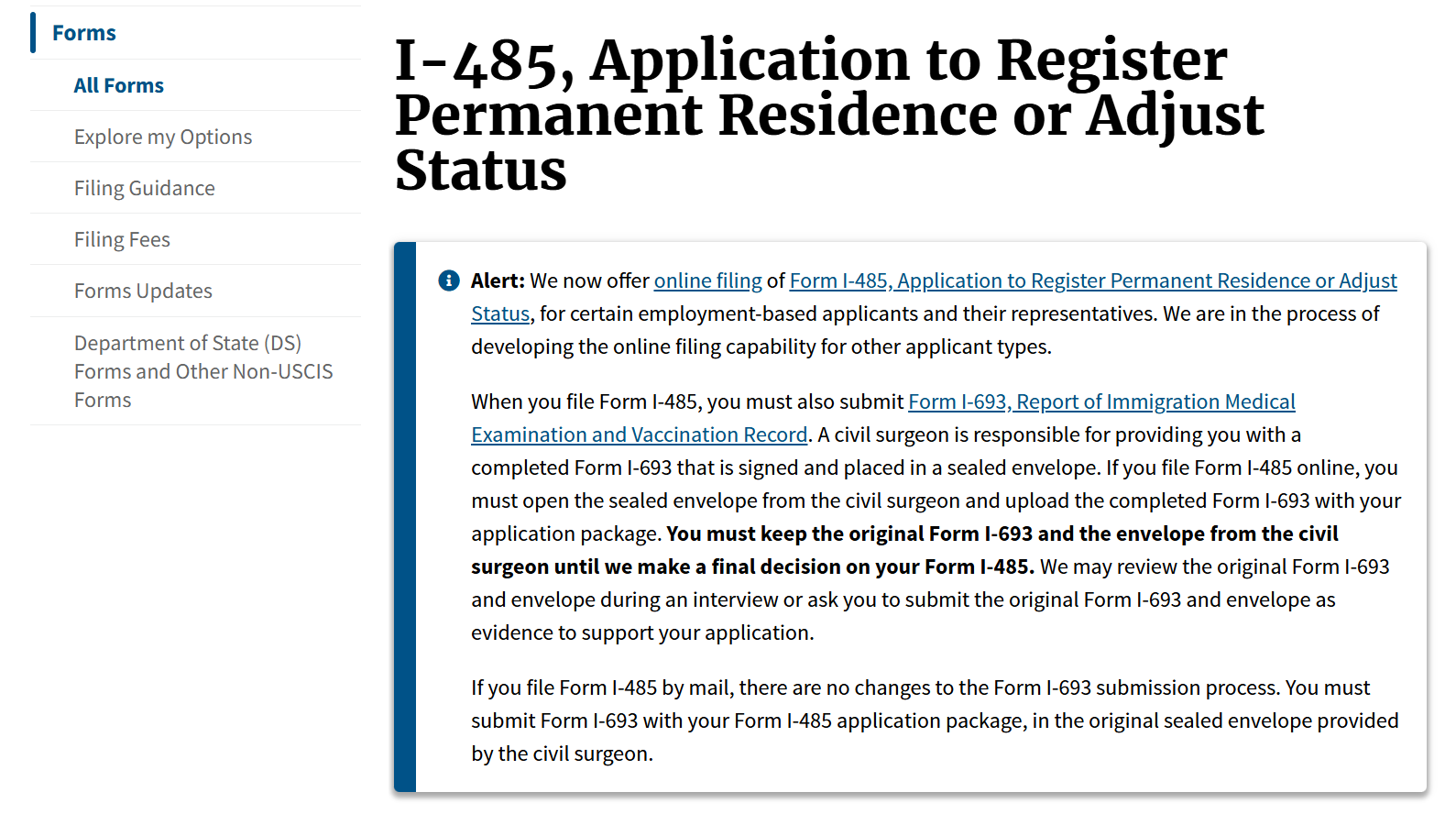
Option 2: Bring the I-693 to your adjustment of status interview. If you file Form I-485 online (available for some employment-based cases), you must open the envelope, scan the I-693, and upload it. Do not mail a sealed envelope for online filings.
What Happens If USCIS Rejects Your I-693?
There are many reasons why your I-693 might get rejected by USCIS, but getting rejected doesn’t mean your green card application is automatically denied. Here is what happens next:
Common reasons for getting rejected include:
- The envelope is opened or tampered with
- Your Civil Surgeon isn't authorized by USCIS
- Required Vaccinations
- You signed Part 2 before the appointment instead of waiting for the doctor
If USCIS rejects your I-693:
You will receive a Notice of Action (RFE or rejection notice) that explains what was wrong. They will also not deny your entire application because of issues related to the medical exam but instead allow you to submit a corrected I-693 or a new I-693.
What to do next:
- Read the notice to determine what happened
- Go back to an authorized Civil Surgeon (the same or a different one)
- Complete the medical exam again if necessary
- Submit a new sealed I-693 by the date specified in the notice
The bottom line: A rejected I-693 is a delay, not a disaster. It adds time and cost, but it rarely ends your green card journey. The key is responding quickly and correctly.
Pro tip: If you receive a rejection notice, don’t panic, but don’t ignore it. Missing the deadline to respond can lead to your entire I-485 being denied. The Visa Way can help you respond correctly the first time.
How Long Is The I-693 Valid?
This is something many applicants get wrong. The I-693 is not valid forever, but the rules changed recently; this rule is still in effect under the latest USCIS policy:
Rule 1: No more 60-day filing window. You used to have to file within 60 days of the doctor’s signature. That rule was removed in December 2024. You can now file your I-485 immediately after the exam, even if it’s been months. No more rushing.
Rule 2: Valid while your case is pending. Once you submit a properly completed I-693 with your I-485, the form stays valid for the entire time USCIS processes that specific application. The old 2-year expiration date is no longer in effect.
Rule 3: Can you reuse it after a denial? NO. If your green card application is denied and you re-file, you need a brand new I-693. You cannot reuse the old one, even if it hasn’t been that long.
The only catch: If USCIS sends you a Request for Evidence asking for a new exam because too much time has passed, you’ll need to get one. But under the current policy, that’s rare.
Medical Conditions That Can Affect Admissibility
Not every health condition makes someone inadmissible. The law is specific. Health-related grounds of inadmissibility include:
- Communicable diseases of public health significance: Historically, this category has included active tuberculosis, syphilis, gonorrhea, leprosy, and certain other conditions. The list is updated periodically by the Department of Health and Human Services.
- Lack of required vaccinations: This is a fixable issue; the Civil Surgeon can administer missing vaccines
- Mental disorders with harmful behavior: Only when the condition is associated with a history of harmful behavior or poses a current threat
- Drug abuse or addiction
Having a chronic illness, disability, or medical history does not automatically make you inadmissible. Many people with complex medical histories go through this process without issues.
Caution: If you have been treated for tuberculosis in the past, bring all documentation, treatment records, chest X-rays, and lab results. A history of TB treatment is not the same as active TB, but you will need proper documentation to prove it.
I-693 Medical Exam Mistakes: What Not To Do
After walking many applicants through this process, these are the mistakes we see most often:
- Going to a non-authorized physician: Your family doctor cannot complete this exam. Only a USCIS-designated Civil Surgeon can fill out Form I-693. Always verify on the official USCIS website.
- Arriving without vaccination records: Missing records often result in re-vaccination, which costs more time and money. Bring everything you have.
- Opening the sealed envelope: Once the Civil Surgeon seals the envelope, it cannot be opened. If it's opened, even accidentally, you'll need to go back for a new exam.
- Signing the form before your appointment: You do not sign Part 2. The civil surgeon tells you when to sign. Doing it ahead of time can get the whole thing rejected.
- Not disclosing medical history: Trying to hide medical conditions can cause problems during background checks and make your case more complicated, so be honest about your medical history.
- Waiting too long to schedule the exam: Civil surgeons can have waitlists of several weeks. Don't wait until the last minute to schedule your exam, especially if your interview is coming up soon.
Tips From Immigration Professionals
Here are a few practical insights that can save you time and stress:
Schedule your appointment early: Give yourself at least 6 to 8 weeks of lead time. Civil surgeon appointment backlogs increased in 2025 to 2026, especially in major cities.
Call ahead and confirm what to bring: Requirements can vary slightly between civil surgeons. A 5-minute phone call can prevent a wasted trip.
Get a copy of your results: Ask the civil surgeon for a personal copy of your exam results before the envelope is sealed. You won’t be able to access it once it’s sealed and submitted.
Use the USCIS Civil Surgeon locator tool, not third-party websites. Some outdated directories list physicians who are no longer authorized.
If you are unsure about your specific situation or have a complex medical history, getting expert guidance before your appointment can make a real difference. The team at The Visa Way works with applicants at every stage of the green card process and can help you understand exactly what to expect. You can get your first consultation free of cost.
civil surgeon appointment