


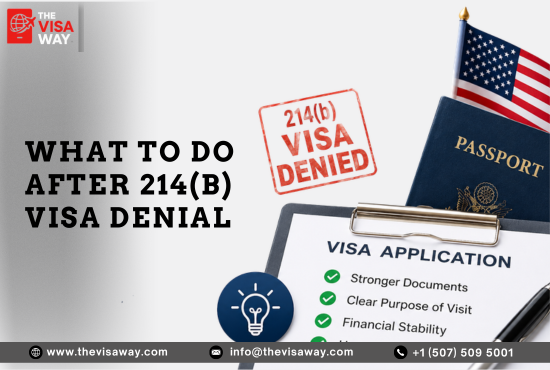
Getting a US visa rejection under 214(b) can feel confusing and even a little personal. One short interview, a quick decision, and suddenly you find yourself questioning what went wrong and whether you will ever get approved or not.
If you’ve recently faced a 214(b) visa refusal, you’re not alone. In fact, it’s one of the most common reasons for US visa rejection, and thousands of applicants successfully reapply every year.
What are the exact causes of a 214(b) visa refusal & how can you avoid repeating the same mistakes? More importantly, what can you do differently to make your next application stronger & more convincing?
Let us help you get closer to your US visa approval!
What Does a 214(b) Visa Refusal Mean?
Section 214(b) is part of the US Immigration and Nationality Act (INA). It says that every foreign national applying for a nonimmigrant visa is supposed to be a planning immigrant unless they can prove otherwise to the consular officer.
That sounds harsh, but here’s the reality: The law places the weight of proof entirely on you, the applicant. You must prove the following:
- You have a residence abroad that you have no intention of abandoning
- Your purpose of travel is genuine and suitable for the visa type you are seeking
- You will leave the United States after your temporary stay ends
If the consular officer is not convinced on any of these points, they must refuse the visa under 214(b).
A 214(b) refusal is not a finding of ineligibility like fraud or criminal history. It simply means you didn’t convince the officer this time. There’s no appeal process, but you can reapply whenever you’re ready.
Most Common Causes of 214(b) Visa Rejection
Based on official US embassy guidance & real applicant experiences, here are the most common reasons applicants receive a 214(b) refusal:
1. Weak Ties to Your Home Country
This is the #1 reason for 214(b) refusals. The officer closed that your connections to your home country are not strong enough to bring you back after a US trip.
Common red flags:
- Unmarried and with no dependents
- No stable job or low income
- No property ownership
- No family duties needing your return
2. Financial Concerns
You could not prove that you can afford the trip without working illegally in the US
What officers look for:
- Bank statements showing enough funds
- Stable income source
- Ability to cover travel, accommodation & daily expenses
3. Unclear or Questionable Travel Purpose
The officer wasn’t sure why you really want to go to the US
Examples include:
- Indefinite answers like “just to look around”
- Inconsistent explanations between DS-160 & interview
- Suspicious itinerary or lack of planning
4. Poor Interview Answers
In a 3 to 5 minute interview, how you answer matters
Common mistakes:
- Hesitating or appearing doubtful
- Giving memorized or robotic answers
- Offering unnecessary information that raises questions
- Opposing your DS-160 form
5. Inconsistent Information
Even small dissimilarities can trigger a refusal. For example, a software developer from India was refused after she forgot to mention one country (Seychelles) in her travel history and misclassified the UAE as part of Central Asia.
What Are Strong Ties in a 214(b) Visa Refusal Case?
Strong ties are the views of your life that bind you to your home country. According to the US State Department, these include professional, social, family & financial connections that would make you return after a trip abroad.
Examples of strong ties:
| Category | Examples |
|---|---|
| Employment | Stable job, business, career progression |
| Family | Spouse, children, elderly parents depending on you |
| Financial | Bank accounts, investments, retirement funds |
| Property | Home ownership, land, rental properties |
| Community | Volunteer work, religious affiliations, school enrollment |
The key is understanding that ties look different for everyone. A 22-year-old student won’t have the same ties as a 45 year old business owner, & officers know this. They evaluate each case individually.
You don’t need every type of tie. You need convincing evidence of the ties that are relevant to your life stage & situation.
Is It Possible to Reapply After a 214(b) Visa Rejection?
Yes, completely. There is no waiting period required by law. A 214(b) refusal applies only to that specific application & does not create a permanent bar.
However, here’s the important point: Reapplying immediately without changing anything almost gets another refusal.
The US Embassy in the Dominican Republic explicitly states that before reapplying, applicants “must wait until they can present clear evidence of major changes in their case.” Many embassies suggest waiting at least 6 months before reapplying to allow time for meaningful changes.
You’ll need to:
- Submit a new DS-160 form
- Pay the visa application fee again (nonrefundable)
- Attend a new interview
- Prove how your circumstances have changed since the last application
When Is the Right Time to Reapply After 214(b)?
Timing is everything. Here’s when you should consider reapplying:
You have a new job with higher salary and stability – Example: Contract-to-permanent employee with a raise
Your financial situation improved significantly – Example: Higher bank balance, new assets, inheritance
Your family situation changed – Example: Got married, had a child, became responsible for elderly parents
You have a clearer, more specific travel plan – Example: Conference invitation, family wedding, specific tourism itinerary with bookings
You previously forgotten or misstated information – Example: Forgot to list a country visited; now you correct it honestly
Complete Steps to Reapply After a 214(b) Visa Rejection
Step 1: Understand Your Rejection Reason
If you received a 214(b) blue letter, it states the standard language. But you need to review your specific interview:
- Which question did you struggle with?
- Did the officer ask follow-up questions on any topic?
- What hesitation or contradiction might they have noticed?
Step 2: Fix Your Weak Areas Honestly
Be honest with yourself. If your ties were weak, do not pretend they were not. Work on making them:
- Improve employment stability
- Build savings specifically for travel
- Create family or community commitments
Step 3: Complete a New DS-160 Carefully
Your new DS-160 must:
- Match your updated conditions
- Correct any mistakes from the previous application
- Include all travel history (every country, correct regions)
- Be firm with what you’ll say in the interview
Consular officers can see your previous applications. If you correct an error, be prepared to explain the change honestly if asked.
Step 4: Prepare Better Interview Answers
Don’t learn a script. Instead, practice explaining the following:
- Why you want to go (specific, honest purpose)
- What you do at home (job, family, responsibilities)
- Why you will return (concrete reasons, not unclear promises)
Step 5: Apply With Confidence
Once your situation has genuinely improved, submit your new application & approach the interview calmly.
Supporting Documents to Avoid Another 214(b) Visa Refusal
Having the right documents doesn’t guarantee approval, but properly managed documentation can. Here’s what to prepare:
| Category | Documents to bring |
|---|---|
| Employment | Employer letter (duties, length, salary), promotion letters, business license (if self-employed) |
| Financial | Bank statements (6-12 months), tax returns (ITR), investment statements, property deeds |
| Family Ties | Marriage certificate, children's birth certificates, family photos, proof of dependents |
| Property | Home deed, rental agreement, bills in your name |
| Travel Purpose | Invitation letters, conference registration, hotel bookings, flight itinerary |
| Previous Travel | Passports with past visas (mainly used visas to US, UK, Schengen) |
According to official guidance, simply bringing more documents does not guarantee approval. The quality & relevance of your evidence matter more than the quantity.
What to Say in Your Interview After a 214(b) Rejection?
Your second interview will be different. The officer will likely ask about your previous refusal. Here’s how you can handle it:
1. Be Honest About the Refusal
If asked, acknowledge the previous 214(b) refusal. Say something like: “Yes, my visa was refused last year. Since then, I have started a new job & I’m now married. I believe my ties to my home country are stronger now.”
2. Keep Answers Brief and Direct
Interviews typically last 3 to 5 minutes. Long, rambling answers create confusion. Answer only the question that was asked & do not add any extra information.
3. Avoid Memorized Speeches
Consular officers can spot rehearsed answers instantly. Practice key points, but speak clearly.
4. Stay Calm and Confident
Nervousness is normal. But if you appear misleading, uncertain or desperate, it raises concerns. Take a breath. Answer clearly.
5. Speak English If You Can
While translators are available in many posts, speaking English directly (even basic English) often creates a better impression. USCIS recommends practicing interview English with a native speaker beforehand.
Mistakes That Lead to Another 214(b) Visa Rejection
| Mistake | Why it Damages |
|---|---|
| Reapplying immediately | No meaningful changes mean the same result |
| Lying or exaggerating | False information creates permanent ineligibility |
| Bringing piles of unsolicited documents | Wait for the officer to ask; offer only relevant evidence |
| Arguing with the officer | Rudeness won't change the decision |
| Mentioning future immigration plans | saying you might study or work later confirms immigrant intent |
| Bringing family members to speak for you | Officers want to hear from you only |
Truth vs Myths About 214(b) Visa Rejection
| Myth | Fact |
|---|---|
| A 214(b) refusal means I’m banned from the US. | It applies only to that application. You can reapply anytime with changed circumstances. |
| More documents guarantee approval. | Quality & importance matter more than quantity. |
| I need a lawyer for a tourist visa refusal. | 214(b) is about your personal circumstances, not legal arguments. |
| Previous visa approvals ensure future approval. | Each application is reviewed independently based on current situations. |
| Waiting longer automatically helps. | Only if something changed. Waiting alone doesn't strengthen your case. |
Still Confused About Your 214(b) Visa Refusal? Let’s fix that!!
If you are not sure why your visa was refused under 214(b), The Visa Way offers free first visa consultations to help you understand your case & prepare a better reapplication.
Our experts review your situation, recognize weak points & create a practical plan fitted to your circumstances.
Book your 1st free consultation today!!!
Wrapping up
A 214(b) refusal may feel personal, but it is not. It simply means the consular officer wasn’t convinced, based on the limited time and evidence available, that you would return home after a US visit.
The good news is that thousands of travelers successfully reapply every year after strengthening their ties, improving their documentation & preparing better interview answers.
Be honest with yourself about your weaknesses. Build genuine connections to your home country. Apply only when your circumstances have truly improved. And when you walk into that interview room, answer with calm confidence.
next visa interview